
A Christmas Memory
How outsiders survive not because they understand, but because they are lucky


I had the honor to serve in Watamu, Kenya, along the coast. A Swahili place, shaped by Islam, trade, tides, and time. Sometimes it felt like a place forgotten by the present, as if the future lived behind you instead of ahead. Paths worn down over thousands of years. Stories layered on top of each other. A community that was always there, and moments when you could walk for miles and feel completely alone.
It is a strange, paradoxical place, like many of the places volunteers serve. Full of life. Full of absence. Some stories from service are light. Some are heavy. Some get retold until they blur. Some are imagined. This one is not.
This is one of those lessons you learn too late, if you learn it at all.
I walked them to the matatu stand. As we moved, the word followed us.
Wazungu. Wazungu. Wazungu.
Called from behind, then from the sides. Men slid into our path, steering with voices and hands, each one tugging toward a different van. To everyone else, we were not individuals. We were white people. Foreigners. Temporary money.
The matatu stand was already loud. Engines idling. Music spilling out of open doors. Boys sent ahead moved fast, grabbing first. Hands reached for backpacks, sleeves, wrists. Not rough. Just certain. Each one selling the same thing. Leaving soon. Space inside. Speed.
There was no line. There never is.
People waiting nearby had grown up with this. They knew what was happening. The trick was not to rush. It was to read the signs and choose well, not to get pulled into a matatu that might sit there for half an hour. Every matatu crew wanted you. You had options. The work was deciding which one was actually about to leave.
I walked them to one and stopped.
An old van with a cracked windscreen and a missing door handle, still expected to work. The paint was chipped and loud, meant to distract from the dents. Music screamed through blown speakers, stripped of bass, reduced to a thin metallic edge. Gospel slid into dancehall and back again. Across the back, a giant image of Monica Lewinsky smiled, sun burned and flaking, watching traffic stack up behind her.
Everyone already inside wanted to leave. That was the leverage.
The dereva and the makanga worked in sync. They knew everyone inside wanted to leave. That was the point. They were not in a hurry. They were competing.
The engine revved. The van crept forward, then settled back. Not leaving. Not stopping. Just enough motion to make people hesitate. Just enough noise to keep attention locked.
At the door, the makanga kept it tight. Knuckles on metal. Palm on the roof. Leaning out, voice rising, selling urgency he had no intention of honoring yet. One more body went in. Then another. Knees pressed together. Elbows locked. Space erased.
They had to be good at this. Every other van was doing the same thing. Miss the moment and you lost money. Push too hard and people walked away. So they balanced it. Pressure without collapse. Motion without departure.
You waited. You watched. You counted bodies, heat, air. You stepped in only when it was close enough to departure to be worth it, unless you wanted a window, unless you were too tired to keep standing in the sun.
That day, it went our way.
Before I could say anything else, my guests were packed in and the van was already rolling, braking hard, cutting into traffic, stopping a block later to take on more people.
Inside, the air settled heavy. Diesel. Sweat. Hot vinyl. Salt from the coast clung to clothes. A fan rattled overhead, moving nothing. Money moved fast. Slapped into a palm. Counted without looking.
That was how they filled it. Not full. Past full. The kind of full where someone says enough and someone else says one more and the door still closes.
Still, it was good to have them.
Being a Peace Corps volunteer, one of the hardest things is the holidays. Christmas. New Year’s. The days you are meant to be with family, but aren’t. Being around other Americans overseas can be difficult too. Familiarity carries its own weight.
People had come from everywhere. From the Uganda border near Lake Victoria. From sites near the Maasai Mara. From towns outside Nairobi like Naivasha. A few from far north. Some traveled two days. Some three. Some eight hours. My closest neighbor lived two and a half hours away. No one was close.
Still, we made the effort to be together.
On that day, we were. We shared food, stories, games, and the simple relief of not being alone. We borrowed each other’s traditions and made something that felt like home, even knowing it wasn’t.
They left the day after Christmas.
I watched that first matatu pull away, packed tight, faces already turned toward different directions. Maybe I would see them again in five or six months. Maybe next year. Nobody knows.
It was enough to have had them.
Those moments matter.

News spreads fast on the coast. It reached me within two days.
That night, Ali, a friend who grew up in Watamu, came by. He sat on my kiti, one I had made a few months earlier.
Have you heard the news, he asked.
There had been another sighting.
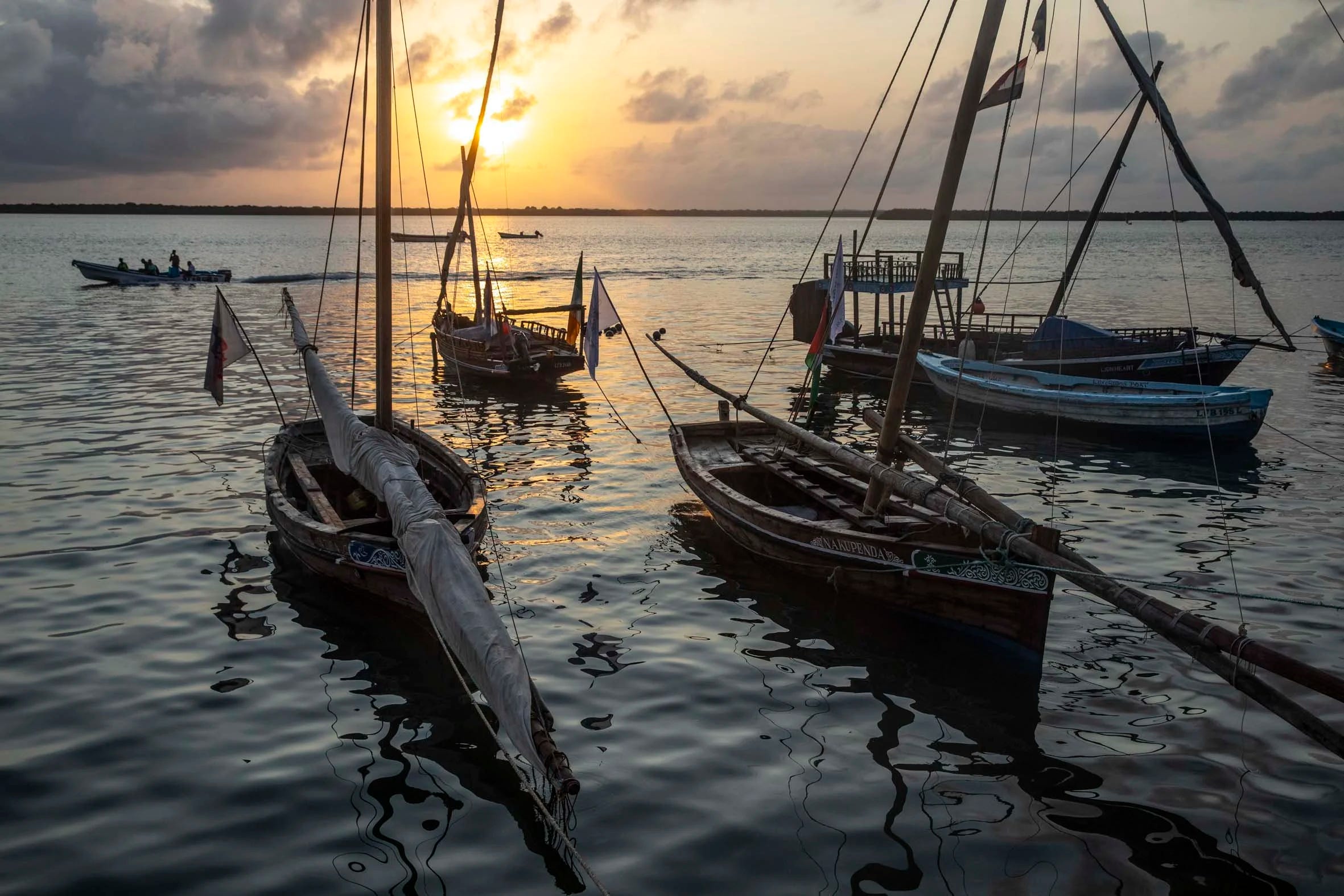
Two brothers. Fishermen. Their boats had been tied up near Kisiwa cha Mapenzi.
Where, I said.
Love Island, he said.
He looked at me hard when he said it, the way people do when they are deciding what you need to know next.
A Swahili proverb came to me.
Ujinga ni wa mtu aliyekuja mbali.
I listened.

Swahili fishermen sleep on their boats because tides matter. Because fish move before dawn. The boats are anchored offshore, near the reef, often within sight of the market. Sleeping there is normal.
Night belongs to the sea.
The brothers had done what they always did. Fished through the day. Brought the catch in. Their wives sold the fish. After dark, they went back out.
Sometime after midnight, one of them woke when the boat tilted. Not drifted. Tilted.
When he opened his eyes, it was already there.
A womanly figure. Pale skin. Hair red like fire.
His chest locked. He screamed and jumped into the water.
The other brother saw enough. Fire-colored hair. A figure where no one should have been. He did not wait. He swam.
They stayed away until morning. They returned with elders. A grandfather. They waited for light.
The boat was still there. Untouched.
Inside was wet.
The next morning I heard the words again as I went about my day. At the vegetable stand. On the path back from work. I did not catch every sentence, but I caught enough.
When I got home, Bibi was already there.
She stood on my porch like she had been waiting a while, which she probably had. Bibi liked my house. It was attached to hers, separated by only a wall. It was quiet. None of her grandchildren ever came over. I suspected that was part of the appeal.
She looked concerned. Or maybe determined. With Bibi it was often both. Either way, I knew she had come for a reason, and that she would tell me, whether I understood every word or not.
Bibi and I had an unspoken agreement. We would each understand two or three words the other said and make up the rest as we went along. My Swahili stalled out somewhere around proverbs. Her English consisted of a few carefully chosen words she deployed when necessary. Our conversations were usually me nodding, guessing, and being corrected with a look.
This time she was focused.
She pointed toward the beach, not far from my house. Shook her head. Pointed upward. Said the same word Ali had used the night before. Majini.
I nodded immediately. Yes. Yes.
After that, I was less certain. She kept talking. I kept nodding. With Bibi, it was always hard to tell when one topic slid into the next, when we had circled back to the same one, or where the conversation was headed at all. It never mattered to me.
Then she gestured toward my kitchen. Toward my first aid kit.
That part I understood very clearly.
She knew I had just been to Mombasa. She knew I had refilled my supplies. Bibi knew a great many things without ever asking. In the end, I handed over two sleeping pills, precious because they were the only thing that let me sleep when the power cut out at night, in the heat, under a mosquito net. Hard to get. Carefully rationed. She took them with a small nod, the kind that suggests not gratitude, but confirmation.
When she left, I uttered to myself, she is something else. I sat for a moment and tried to decide what had just happened.
Had she come because she was worried about me or what she walked away with?

Months later, at a midyear conference in Nairobi, people arrived in clusters, hugging, talking over one another.
Sarah found me almost immediately. She hugged me hard and thanked me. Spending Christmas together had mattered more than she expected. She had been homesick.
We talked. Then she laughed, remembering the night after the games were over, after everyone had eaten.
It was her first time in Watamu.
The beach. The moon. How empty it felt. She said she went swimming without thinking. Got turned around by the reef. Could not tell which way was shore. So she swam toward a boat to get her bearings.
She said she must have startled someone. A man yelled and jumped into the water, swimming back to shore.
Anyway, she said, who fishes at night? I responded, who skinny-dips on Christmas Eve?
She smiled. Then suggested we do it again next year.
I hesitated. Just a moment.
Maybe next time we should go somewhere else, I said. Or come visit your site instead.